
How Do Mortgage Interest Rates Affect Home Prices?

How Do Mortgage Interest Rates Affect Home Prices?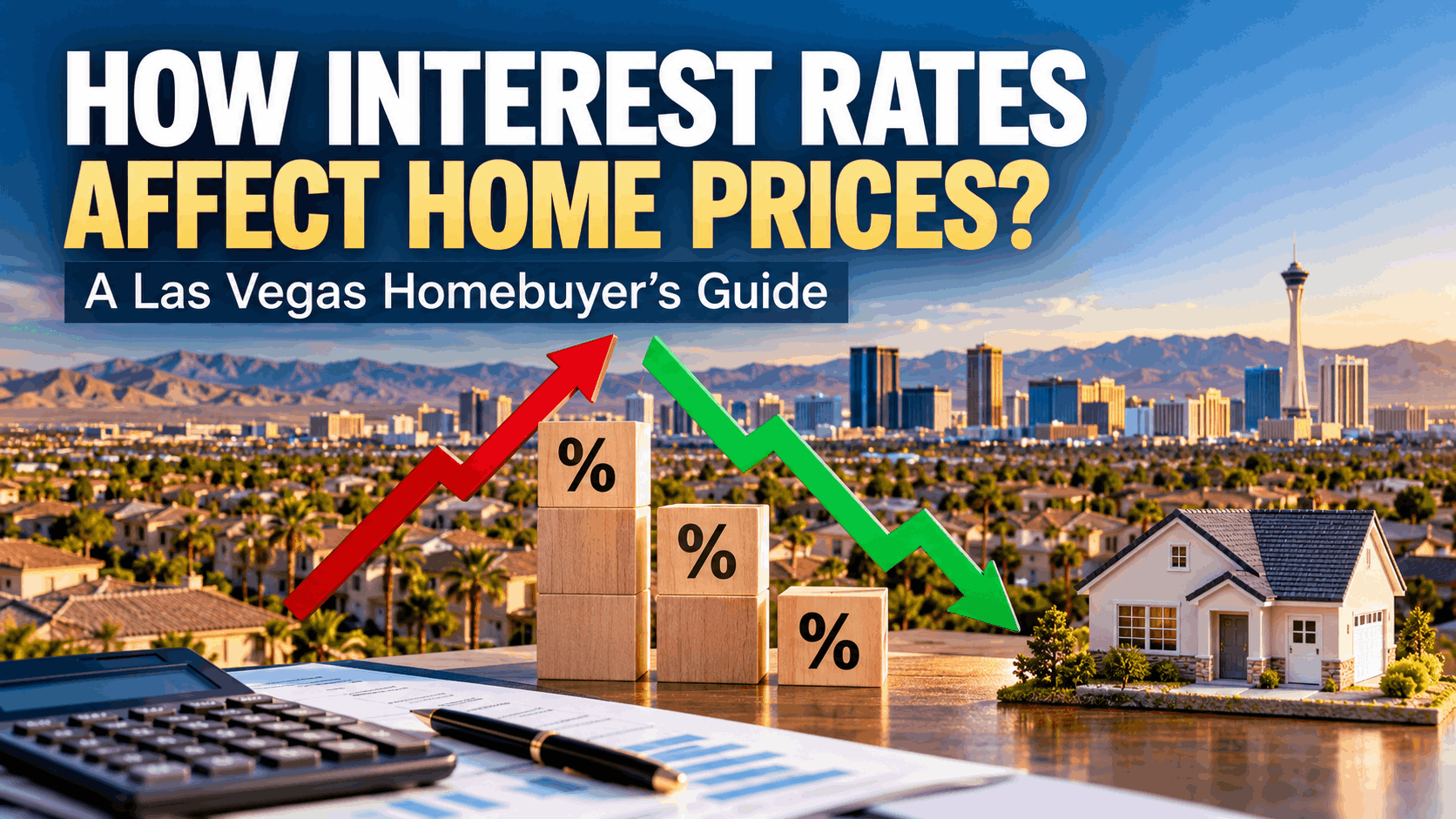
By Peter Ferrer | Local Las Vegas Realtor
Have you ever wondered why home prices sometimes rise even when mortgage interest rates are high? Or why everyone starts talking about buying a house when rates begin to fall?
Mortgage interest rates play a major role in the real estate market. They influence how much buyers can afford, how many people are shopping for homes, how sellers price their properties, and how quickly homes sell. But here's something many people misunderstand: Mortgage rates and home prices do not always move in opposite directions. Lower rates can help buyers afford more expensive homes, but if demand increases faster than the supply of available homes, prices can rise. Likewise, higher rates can reduce demand without necessarily causing home prices to fall. As a Las Vegas Realtor, I believe understanding this relationship can help buyers and sellers make more informed decisions. Let's break down how it works and what it means if you're thinking about buying or selling a home in Southern Nevada.
- How Higher Interest Rates Affect Home Prices When mortgage rates increase, purchasing a home becomes more expensive for buyers who need financing. Let's say a buyer is comfortable spending $2,000 per month on principal and interest. If mortgage rates rise, that same payment may no longer be enough to purchase the home they originally wanted. The buyer may need to look at a less expensive property, increase their down payment, or postpone purchasing.
When many buyers face this same challenge, the market can experience several changes:
- Fewer qualified buyers: Some buyers no longer qualify for the mortgage amount they need.
- Reduced demand: Other buyers choose to wait for more favorable financing conditions.
- Longer selling times: Homes may take longer to sell when fewer buyers are competing.
- More negotiating power: Buyers may have greater opportunities to negotiate prices, repairs, or closing-cost assistance.
- Potential price adjustments: Some sellers may lower their asking prices to attract buyers.
However, higher mortgage rates do not guarantee falling home prices. If an area has limited housing inventory, strong employment, population growth, or continued demand, prices may remain stable or even increase despite higher borrowing costs. The important distinction is that higher interest rates can put downward pressure on prices, but other market conditions determine how much prices actually change.
- How Lower Interest Rates Can Push Home Prices Higher Now let's look at the other side. When mortgage rates fall, monthly payments become more affordable for buyers borrowing the same amount of money. A buyer who previously could not qualify for a particular home might now qualify. Another buyer may discover that their budget allows them to consider a more expensive property.
Lower rates can bring more buyers into the market, increasing competition for available homes. If the number of buyers increases while the number of homes for sale remains limited, sellers may receive more offers and gain greater negotiating power. In competitive markets, this can lead to:
- More buyers entering the market.
- Increased competition for desirable homes.
- Multiple-offer situations.
- Faster sales.
- Rising home prices.
This explains an important real estate concept: A decline in mortgage rates can improve affordability while simultaneously putting upward pressure on home prices. For example, suppose a home is listed for $400,000. If rates fall and more buyers enter the market, the home could attract enough interest to sell at a higher price than expected. That does not happen in every neighborhood or market. The outcome depends on available inventory, buyer demand, employment, household incomes, and other economic factors.
- A Real-World Example: How Interest Rates Affect Your Monthly Payment Let's use a $400,000 home to demonstrate how mortgage rates affect affordability. Assume a buyer makes a 20% down payment of $80,000 and finances the remaining $320,000 with a 30-year fixed-rate mortgage. Here is how the estimated monthly principal-and-interest payment changes at different interest rates:
|
Mortgage rate |
Monthly payment |
|
5.5% |
$1,817 |
|
6.0% |
$1,919 |
|
6.5% |
$2,023 |
|
7.0% |
$2,129 |
|
7.5% |
$2,238 |
These are illustrative estimates, not current rate quotes. Payments are rounded and exclude property taxes, homeowners insurance, HOA fees, mortgage insurance, and other ownership expenses.
Notice the difference between a 5.5% rate and a 7.5% rate.
The monthly principal-and-interest payment increases by approximately $421. That is more than $5,000 per year. For many households, that difference could determine whether a particular home fits comfortably within their budget. It also explains why mortgage rates matter so much to the real estate market. When financing costs rise, buyers may reduce their target purchase price even if sellers have not changed their asking prices.
- Should You Wait for Interest Rates to Fall Before Buying a Home? This is one of the most common questions prospective buyers ask. Unfortunately, nobody can predict mortgage rates with certainty. Rates can move in response to inflation, bond-market conditions, economic expectations, and other factors. Waiting for rates to decline may make sense for someone who needs more time to save for a down payment, improve their credit, or strengthen their financial position. However, waiting also carries uncertainty. If rates fall, more buyers may enter the market. Increased competition can make certain homes more expensive or reduce opportunities to negotiate. On the other hand, if rates rise, waiting could make the same home more expensive to finance.
Consider these questions before making a decision:
- Can you comfortably afford the monthly payment at today's available rates?
- Do you have enough savings for your down payment, closing costs, and emergency expenses?
- Do you expect to remain in the home long enough to make purchasing worthwhile?
- Have you compared mortgage programs and offers from different lenders?
- Does buying make sense for your personal and financial circumstances?
Buying a home should not depend entirely on trying to predict the bottom of the interest-rate market.
For buyers who are financially prepared and plan to stay in their home, purchasing at an affordable price with manageable payments may make sense even when rates are not ideal.
If rates decrease later, refinancing might be an option, subject to qualification, closing costs, and the terms available at that time. Refinancing is never guaranteed, so it is important to choose a loan you can afford without relying on a future rate reduction.
- Should Sellers Wait for Interest Rates to Drop Before Listing? Sellers face a similar question.
Lower mortgage rates can bring more buyers into the market, potentially improving demand for homes. Some sellers may therefore prefer to wait for more favorable financing conditions. But waiting is not automatically the best strategy. If you need to relocate, downsize, move closer to family, or sell an investment property, your personal timeline may matter more than trying to time the market.
Before deciding when to list, consider:
- Recent sales of comparable properties in your neighborhood.
- The number of competing homes currently for sale.
- How long similar properties are taking to sell.
- Whether buyers are receiving closing-cost assistance or other concessions.
- Your equity position and the cost of selling.
- Your plans for your next home.
If you are thinking about buying or selling a home in Las Vegas, understanding how these factors work together can help you make a more informed decision. I'm Peter Ferrer, a local Las Vegas Realtor who helps buyers and sellers understand the market, evaluate their options, and develop a strategy that fits their goals. Whether you're a first-time homebuyer, a military family, an investor, or a homeowner considering selling, I'd be happy to help you understand what current market conditions mean for you.
Visit LocalVegasProperties.com to learn more or get in touch. Let's discuss your real estate goals and make a plan that works for you.
This article is for general educational purposes and is not financial or mortgage advice. Mortgage terms, rates, home prices, and market conditions change. Consult a qualified mortgage professional about your individual financing options.
Categories
Recent Posts







GET MORE INFORMATION